






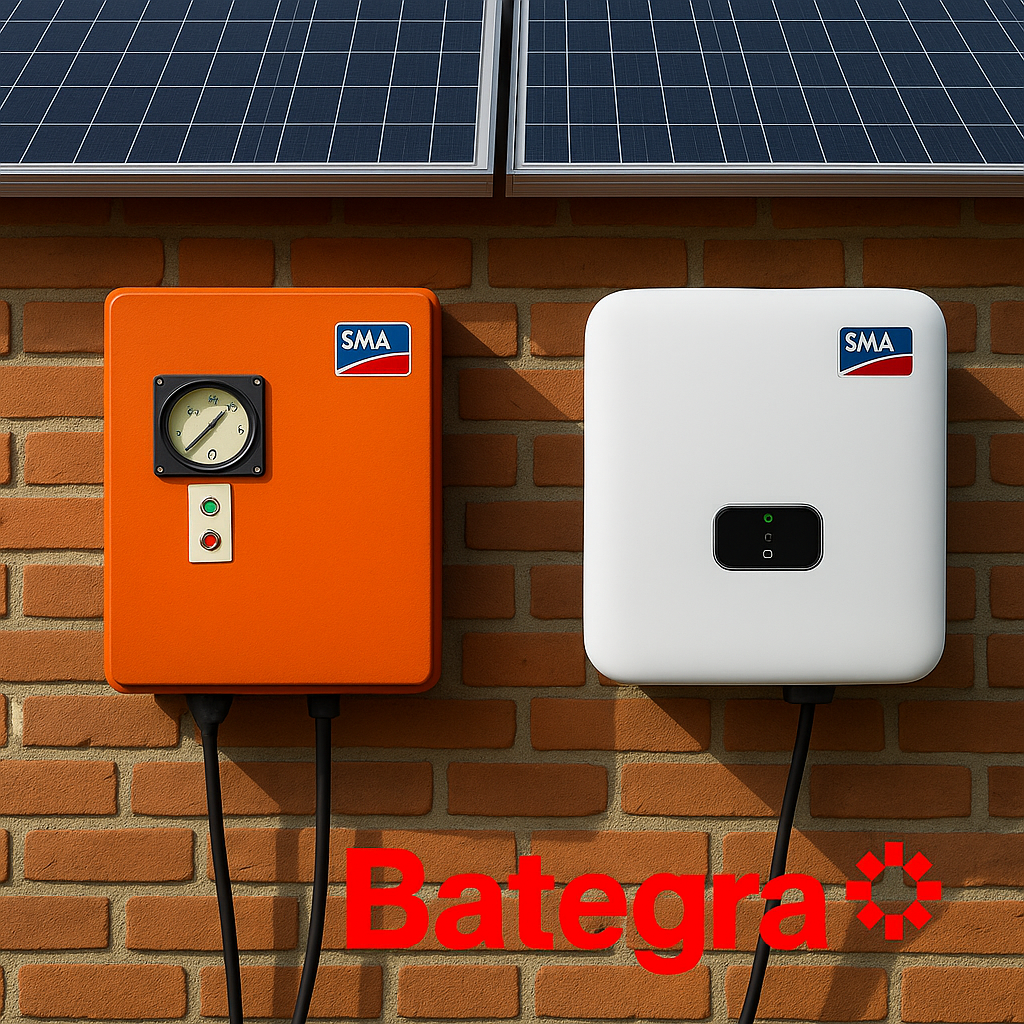
Understanding Solar Inverter Technology: A Complete Guide
Learn how solar inverters convert DC power from solar panels into usable AC electricity for your home or business.
Understanding Solar Inverter Technology: A Complete Guide
Introduction
Solar inverters are the heart of every photovoltaic (PV) system. They convert the direct current (DC) produced by solar panels into alternating current (AC) that powers your home, business, or industrial facility. First inverters were built in end of 1960s but high scale as we now know were designed and produced by SMA in 1991.
This guide will explain how inverters work, outline the main types, highlight key selection criteria, and introduce leading manufacturers trusted in the Baltics, and Central/Eastern Europe.
1. A Short History of Solar Inverters
The first commercial solar inverters appeared in the late 1970s, but early models were inefficient, and required frequent maintenance. Technological breakthroughs in power electronics and Maximum Power Point Tracking (MPPT) in the 1990s dramatically improved efficiency. Today, modern inverters can exceed 98% efficiency and integrate smart features like remote monitoring, grid support, EV charging and battery storage management.
2. How Solar Inverters Work
- DC to AC conversion: Matches the voltage and frequency of the local grid.
- MPPT: Continuously adjusts to maximize energy harvest from panels, even with shading or temperature changes.
- Safety & compliance: Provides overvoltage protection, anti-islanding, and surge suppression.
- Monitoring: Modern inverters connect to cloud via apps, giving you real-time data.
3. Main Types of Solar Inverters
String Inverters | Medium/large arrays with minimal shading | Proven, cost-effective | Single point of failure
Microinverters | Complex roofs, shading issues | Panel-level optimization | Higher upfront cost
Hybrid Inverters | PV + battery storage | Integrated backup & storage control | More expensive
Central Inverters | Utility & large C&I | High capacity | Requires skilled installation
4. Key Selection Criteria
- System Size & DC/AC Ratio (oversizing for better yield)
- Efficiency & Reliability (Euro efficiency ≥ 97%)
- Number of MPPT Inputs (flexibility for multiple roof orientations)
- Battery Compatibility (future-proof for storage upgrades)
- Warranty & Service (5–10 years standard, extendable)
5. Leading Inverter Manufacturers (available via Bategra)
- Sungrow – Global leader, strong hybrid line, excellent service in Eastern Europe.
- Solis – Cost-effective, reliable string and hybrid inverters.
- Fronius – Premium Austrian brand, excellent monitoring and durability.
- Huawei – Advanced hybrid systems with AI diagnostics.
- Deye– Popular for hybrid systems.
- Alpha ESS - wide range of products.
6. Installation & Maintenance Tips
- Place in a shaded, well-ventilated area.
- Regularly check firmware updates. If inverter is working perfectly, some times not recommended to update.
- Clean dust, filters and ensure good airflow.
- Monitor performance monthly to detect issues early.
7. Conclusion & Next Steps
The right solar inverter ensures your PV system operates efficiently for decades. Whether you are powering a home, a commercial building, or an industrial facility, selecting a trusted brand and correct type is essential.
Browse Bategra’s full inverter range or contact our team for tailored recommendations.